
To see some of the major archaeological sites of the Peloponnese Peninsula (Ancient Corinth, Mycenae, and Epidaurus) we based ourselves in the coastal city of Nafplio for 4 nights. It would have been possible to see them all in one crazy long day trip from Athens, but we are certainly glad that we didn’t; Nafplio is worth a visit in its own right and is a charming town. (Of course there are 3 more of Greece’s 20 UNESCO World Heritage Sites in the far west of the Peloponnese, including Olympia, but we’ve been to Olympia on a previous trip so didn’t add more driving!)
Nafplio is famous for being the first capital of independent Greece in 1822. The hilly Old Town with its restaurants and small pensions and hotels was a perfect base because it is almost fully pedestrianized so that everything is within a short walk (as long as you can manage stairs!). However parking on the outskirts was an issue due to the Mediterranean Yacht Show taking over 80% of the main lot.
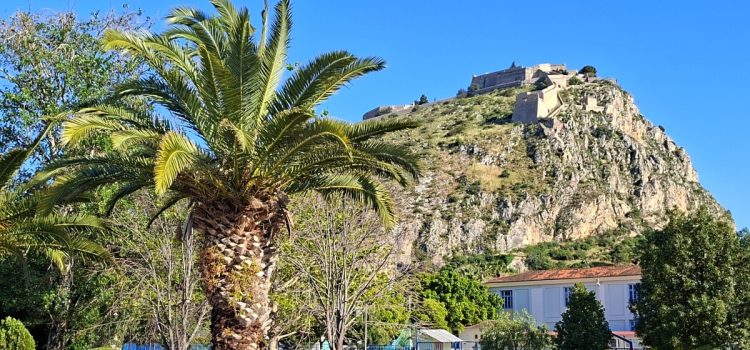
It’s a bit amusing that today’s 500 year old “Old Town” of Nafplio didn’t even exist until ~1480 AD when the Lower Town was created. Before that, for 3,000 years the rocky promontory of Acronafplia was occupied by Mycenaeans, Greeks, Byzantines, Franks, and the Venetians. It was the Venetians that really put Nafplio on the map. In the first Venetian period, they not only took over Acronafplia and created the Lower Town, they built Bourtzi Fortress on a small islet in the harbour. in the early 1700s (their second occupation) they built the great Palamidi Fortress on a 216 m hill above the town. All for nothing as it turns out; the Ottomans swept in and took over Palamidi without a fight, and then adding insult to injury they proceeded to finish building Palamidi using the Venetian plans!
The Ottomans didn’t have much luck either. In 1822, during the War of Greek Independence, Greek forces captured Palamidi without firing a shot and then turned its cannons on the Acronafplia Fortress 150 m below and took that over too.
As can be seen from the pictures below, we visited both the Acronafplia and Palamidi fortresses and there’s not much to see. There’s a hotel at the Acronafplia site but otherwise one is free to roam among the crumbling walls and fields of flowers. Great views in all directions though! And we just happened to be up top on the Wednesday evening when the Mediterranean Yacht Show ended with dozens of yachts honking horns and setting off distress flares. (Video below.)
Thursday, May 6, 2026 – Nafplio
We spent one full day in Nafplio. To begin the day, we drove up to Palamidi Fortress which is an official tourist attraction, but like Acronafplia there is nothing much to see other than the walls of the bastions. There is one tiny room that tourists can enter, a jail cell from its days as a military prison, otherwise it’s just a viewpoint.
Besides strolling the streets of Nafplio, popping in to some small churches, and going to some great restaurants, we only did one thing in the town itself. We visited the Nafplio Archaeological Museum. It was a great regional museum that traced the entire 35,000 year history of humans in the Nafplio area (starting in the Franchthi Cave). A couple of favourite displays were the Mycenaean bronze body armour known as the Dendra Panoply (complete with a boars’ tusk helmet), and an entire case of glass objects that have miraculously survived intact for thousands of years.
On our last evening in Nafplio we strolled the pedestrian lanes, had a gelato, and snapped some sunset pictures. Then the next morning we headed back to Athens to catch a flight out to Mykonos. Conveniently, our first rain of the trip was on a travel day so it didn’t bother us a bit!
Images of Nafplio
See our pictures of Nafplio on Flickr:
www.flickr.com/photos/100countries/albums/72177720333621449
See links to all of our posts for this trip on 2026-2 – Greece and Albania.