
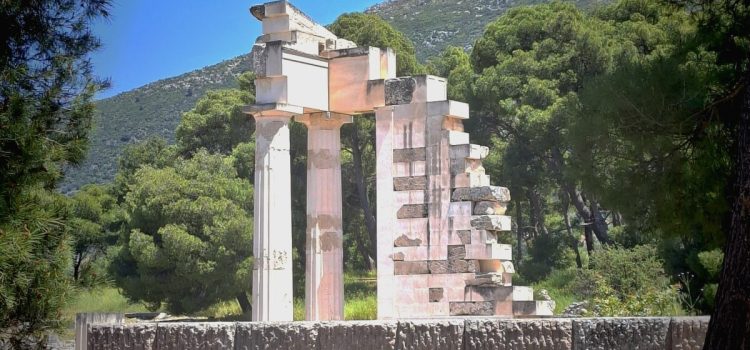
Saturday, May 2, 2026 – Vancouver, transit LHR, Spata (near Athens airport)
We left YVR in the early evening, and upon arrival in Athens the next evening we stayed at Spata near the airport so that we could pick up our rental car and drive to the Peloponnese in daylight hours the next day.
Sunday, May 3, 2026 – Spata, Corinth, Ancient Corinth, Nafplio
After breakfast at the local coffee shop, we Ubered back to ATH to rent a car. We drove to the Pelopenese Peninsula where we based ourselves in Nafplio for 4 nights, but we stopped in Corinth and then Ancient Corinth on the way, taking most of the day to reach Nafplio.
The stop in modern Corinth was to see the Corinth Canal, an engineering marvel during its day. In the 7th century BC, the Greeks constructed an overland portage road, named the Diolkos, to drag ships over the 6.4 km isthmus rather than sail around the dangerous headland. A canal was dreamt of, and even started by Emperor Nero in 67 AD, but not completed until 1893! Unfortunately, the rapid switch to steamships and the increase in vessel size made the Corinth Canal obsolete within a few years of its completion. Still a very impressive sight though.
Ancient Corinth, only a few kilometres away, unfortunately suffered the same fate as as the eponymous canal but for the opposite reason; it was too successful. Being a huge trade centre (due to the Diolkos), ancient Corinth was a tempting target and so was repeated sacked then rebuilt in cycles over 1,000 years. Earthquakes in the 300s AD pretty much finished the job of the city’s destruction, but Acrocorinth, the acropolis of the Greek city, remained as a fortress fought over for another 1,500 years.
We made a brief stop to see the the monumental temple of Apollo and small theatre at the archaeological site. The highlights of the onsite museum were the “Twin Kouroi”, marble funerary statues recovered from looters before arriving at the museum. Finally, a short drive up the hill brought us to Acrocorinth, It was more impressive for its views than anything on the site, but certainly generated some awe at the effort put in over the centuries at building such huge fortifications on top of the mountain. (In vain as it turned out.) In the late afternoon we continued into Nafplio.
Monday, May 4, 2026 – Nafplio, Mycenae
The next day in the Peloponnese was a trip back in time to the first Greek-speaking civilization on the mainland, the Mycenaean civilization (that grew from Minoan influence on Crete). We went to the UNESCO listed fortress city of Mycenae to explore the palace of the Mycenaean kings and some of the earliest burial finds in Greece. While the Mycenaeans may have been Greek speakers, they didn’t have a written language in the Greek alphabet (that came over the next 1,000 years) and so visitors to the site simply marvel at the incredible construction work left behind without much clue about any detailed history. They built palace/fortresses with huge stones, one of which was 4 times the size of any block in the pyramids at Giza.
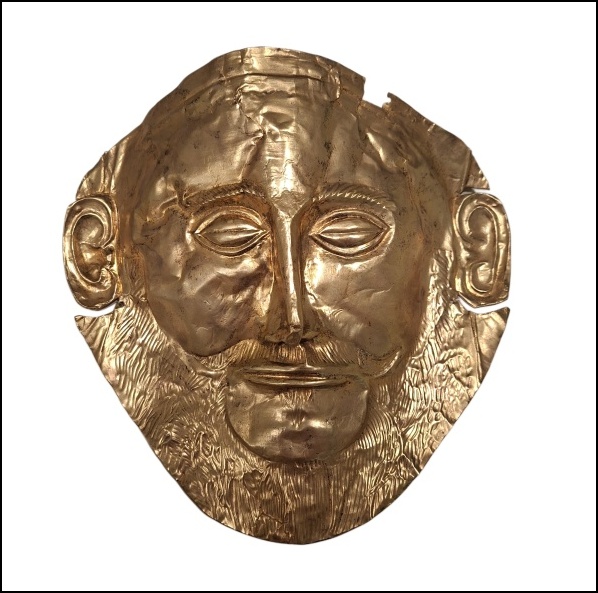
Pretty much the only historical records of the Mycenaean civilization available are what can be pieced together from grave goods. At Mycenae there was one particularly famous burial site, Grave Circle A, which was excavated by Heinrich Schliemann (excavator of Troy). His most famous find was the so-called Mask of Agamemnon shown below. “So-called” because the mask predates the Trojan War by 300-400 years. And the one in the on-site museum is a replica; the real one is safe in the National Archaeological Museum in Athens.
After the last stop at Mycenae, we drove back to Nafplio and after a little jet lag recovery nap we headed out for dinner. Greek food is always a favourite, and the evening’s local specialty, dolmathes (vine leaves) made with cabbage rather than grape leaves, were great!
Monday, May 4, 2026 – Nafplio, Epidaurus
The following day, after a rather slow start and leisurely breakfast, we jumped in the car to visit another UNESCO World Heritage site, the Sanctuary of Asklepios at Epidaurus (a sanctuary dedicated to Asklepios, god of healing). The setting in pine woods was lovely, and its remoteness from much of anything certainly contributed to its preservation.
The star of the show here is the theatre, considered the best preserved example of 132 (!) ancient theatres in Greece, probably because it was buried over time when the site was closed by a Christian emperor in the 5th century AD. A couple of earthquakes completely ended its use, the site was abandoned, and the theatre was not excavated until the 1870s. We performed the obligatory testing of the acoustics of the remarkably well preserved theatre, then walked around the hillside to the onsite museum.
Our guidebook rather uncharitably called it a “dusty little old-school museum” but it wasn’t that bad. Light on star attractions like the previous day’s Mask of Agamemnon to be sure, but some nice pieces. One mystifying object on display was a perfectly preserved Corinthian capital with not a sign of weathering. It was apparently deliberately buried by the builders of the sanctuary, but the reason remains unknown.
After the museum we ventured into the sanctuary (Asklepieion) to try to imagine what might have once stood there, although it was difficult to tell from the bare foundations and the few reconstructed bits how the hospital may have worked. The actual medical treatments seem to have been limited to healing waters, snakes, and the power of prayer, although there were some rudimentary surgical instruments on display in the museum. Whether it was the waters, snakes, prayer, or surgery that helped, there were some tablets in the museum from grateful patients lauding their miracle cure. (Of course, those who died wouldn’t have had a tablet of thanks chiselled up would they?)
After finishing our tour of the Asklepieion we headed back to Nafplio. We had enough time that evening to begin our exploration of the sights within the town; see our separate post about this charming city.
Check out our photos of Ancient Corinth, Mycenae, and Epidaurus on Flickr:
www.flickr.com/photos/100countries/albums/72177720333579352
See links to all of our posts for this trip on 2026-2 – Greece and Albania.