
Southern Albania: Five Days of History, UNESCO Sites, and Tourism Hot Spots
A full 7-10 days would have been needed to see the whole country from north to south. But because the north is all about the hiking and the mountain scenery in the Albanian Alps, we decided to concentrate on the south. We live on a mountainside in Vancouver, Canada so we wanted to see things in Albania that we cannot see at home! The south of Albania has almost all of their historical sites, both of their Cultural UNESCO World Heritage List sites, and is the destination for the majority of tourists looking for a beach holiday.
Friday, May 22, 2026 – Tirana, Belsh, Berat
Our tour began rather inauspiciously as the car was late arriving. However, our driver/guide, Santiano, kept us updated on WhatsApp and we started off only 30 minutes late. Santiano quickly proved to be a fantastic guide. As a driver, he knew the roads well, as a guide he was pretty good at providing info regarding the historical sights that we saw, but it was as a native Albanian with an excellent grasp of English and the ability to offer insights into the evolution of the country that he really shone.
Once we got outside Tirana we were surprised to see that the countryside around us was not just hilly but mountainous. We checked later and found that 70% of Albania is mountains and we didn’t see any low lying, fertile plains until later in the trip.
We stopped for a coffee in the town of Belsh right beside Lake Belsh (one of 84 karst lakes in the area). Albanians are great coffee drinkers and the great thing is that sweet treats are frequently an accompaniment. With our diver (and us) fully caffeinated, we headed for our first UNESCO WHL stop, the “City of a Thousand Windows”, Berat. The city’s UNESCO listing says “…Berat bears witness to the coexistence of various religious and cultural communities down the centuries.” That is certainly true of the imposing castle on the hill above the town. Founded by the Illyrians, then sacked and rebuilt by the Romans, the castle and its city were also ruled in turn by the Byzantine Empire, the Despotate of Epirus, and the Ottomans. Bits and pieces from all of those cultures are within the walls of the castle, although Byzantine Orthodox churches predominate and there is but one mosque. There’s a nice museum within St. Mary of Blachernae Church.
After the castle and its museum we had a leisurely, late lunch in the alleyways near the Gorica Bridge. The final tour stop of the day was a winery in the countryside for a tasting of Albanian wines, which was highly enjoyable for both the views and the wines. We were dropped off at our hotel back in Berat and had some free time to explore the beautiful pedestrian street leading down to the old town. Unlike the castle area, the historic old town is mostly Ottoman with lots of mosques and buildings from that era, including the Pasha’s Gate (next to the ruins of the Palace of the Pashas naturally). In the evening, we hiked up through the white houses of the old quarter, and then navigated to an attraction that was a hot tip from Santiano; Berat’s “Wine Window”. What a great concept! You bend over nearly double, ring a bell on the ledge of an open window, hand over a few lek, and very shortly a hand appears offering your glass of wine. After you’ve enjoyed your wine (while standing in the narrow alley chatting with the locals and the few tourists with great GPS skills), you place your glass back on the ledge and carry on. Of course the bell is right there if you want another round. Definitely the highlight of our evening in Berat.
Saturday, May 23, 2026 – Berat, Apollonia, Gjirokaster
After breakfast in Berat, we headed off to visit Apollonia. Founded as a Greek colony in the 6th century B.C. on land of local Illyrian tribes, most of what can be seen at Apollonia today is from the Roman era, although a couple of churches are also on the site. After visiting so many ancient sites within Greece, it was interesting to see a site that was a colony of a larger Greek civilization, which in turn became a major city in the Roman empire when they took over. Interestingly, Apollonia never became a significant settlement in the Byzantine and Ottoman eras that followed; a major earthquake in late Roman times changed the course of its river and destroyed its port. Silt covered over the city and it wasn’t until the 20th century that the impressive ruins that we can see today were uncovered. There were still a few inhabitants through the centuries though, who built Orthodox monasteries and churches. The cloisters of one of those old churches now houses the museum on site.
Our next stop was Gjirokaster, a city that shares its UNESCO WHS billing with Berat. En route, we did finally see some of the fertile plains of Albania, although by our lunch stop we were back in the hills and mountains. Our break was at the imaginatively named town of Cold Water, Albania’s most famous roadside rest stop. We didn’t fill any water bottles from the natural springs gushing from the rock faces, but did enjoy dining at one of the restaurants built on a platform directly over the waterfalls and winding river below.
Upon arrival in Gjirokaster we immediately wound up the hill to its castle. Just finding a parking spot in the steep streets by the castle entrance was a challenge, but turned out to be rather fun! A local shop owner let us park across from his store and helpfully pointed to the rock to wedge under the back tire to keep the car from rolling away. Then our guide, Santiano, struck up a conversation and through broken English and simultaneous translation we heard all about the shopkeeper’s history as a baker in the Albanian army back in the day. He even went in to grab a photo to show us; one guy in a baker’s apron with a half-dozen soldiers in uniform! Almost made going to the castle an anti-climax.
The Gjirokaster castle and museum can best be described as quirky. Features include a Museum of Armaments, some bizarre political propaganda sculptures, the political prison cells, a captured US spy plane, the artillery vault (just what it says on the label), with the whole eclectic mix topped off with a rooftop stage built specifically to host the Gjirokaster National Folklore Festival and a Clock Tower. (There is no clock, just the tower, but the name remains so presumably there used to be one.) Very entertaining, although a bit perplexing. As a bonus, on our way down we passed the stall of a guy selling copies of most of Enver Hoxha’s books. Yes, the crazy, paranoid, communist dictator apparently authored at least 70 books.
We descended down into the “City of Stone” and toured one of the multi-storey houses, Zekate House. We were able get a sense of how the wealthy must have lived in their miniature stone fortresses back in the city’s heyday from the 17th to 19th centuries. We headed back to our hotel in the rain. Fortunately, the intermittent rain stopped by dinner time so we were able to climb the insanely steep streets to the bazaar which was pretty much a series of tourist shops. The restaurant that we chose was, however, great!
Sunday, May 24, 2026 – Gjirokaster
After breakfast, we returned to the castle but this time we went under the mountain to the Gjirokaster Cold War Tunnels. Basically a huge bomb shelter to house the country’s political elite in case of attack. Of course all of the furniture and equipment that is there today and was simply left in place decades ago looked pretty derelict, but a lot of it looked like it was probably junkyard salvage when it went in. Between the derelict equipment and the fact that there was just one communal washroom for 300 people, it’s probably a good thing that the facility was never tested in action!
From under the ground we drove into the hills to attraction high above the ground, the Ali Pasha Bridge. The “bridge” is actually a section of an aqueduct built in the early 1800s by Ali Pasha (as you might guess from the name). The stone aqueduct was obsolete just 100 years later and Albania’s King Zog tore down all but 40 m of the 12 km long waterway to get stone to build his prison for political dissidents. At just 1.4 m wide (~4.5 feet) and 16 m high (over 50 feet) we left crossing it to the goats and a few 30-something tourists in need of the perfect shot for Insta. We stopped for a drink and to buy honey on the way back to the vehicle, and continued out to a local farm for lunch in the garden.
We were meant to have the afternoon free to look around Gjirokaster on our own, but unfortunately it rained that afternoon and we were forced to just kill time reading at the hotel. With the threat of rain still looming we had dinner at the closest restaurant that we could find.
Monday, May 25, 2026 – Gjirokaster, the Blue Eye, Butrint, Ksamil, Himara
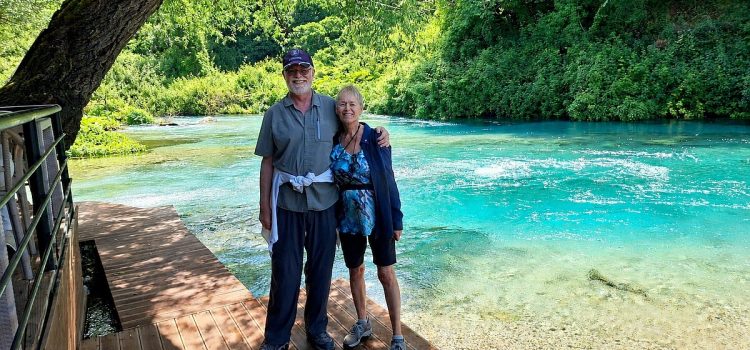
We checked out of our hotel and made the short dive to a natural phenomenon like we’ve never seen before in 50 years of travel, the Blue Eye. We were lazy and took the little train up the path and emerged at the source of an impossibly turquoise blue river emerging straight up from a hole in the ground. The famous Blue Eye (Syri i Kaltër) in southern Albania, is a mesmerizing freshwater spring where crystal-clear water pumps up at a rate of over 18,000 litres of water per second from a mysterious underwater cave. No one knows exactly how deep it is—the immense water pressure pushes divers back to the surface after 50 meters! It stays a freezing 10°C (50°F) all year round, creating a vibrant sapphire and turquoise “eye” effect right in the middle of a lush oasis. I think that our guide was having a bit of fun with us when he said “Surely you must have something like this in Canada?”; we were forced to admit that we don’t!
From natural wonder we then headed for a UNESCO WHS wonder, Butrint. But in order to get there we had to pass through the “village” of Ksamil and the the neighbouring city of Saranda, ground zero for Albanian visitors and a warning lesson on how not to do tourism. Just 20 years ago, Ksamil was a true village with fewer than 2,000 permanent residents, Today there are not many more than 3,000. But every summer the village imports around 6,000 seasonal workers to handle an estimated 300,000 to 500,000 visitors! Nearby Saranda adds another half million. And the rampant over-development is truly ugly with over 1,100 hotels, AirBNBs etc. crammed into the Ksamil “beach ghetto”. We did have lunch that was actually very tasty Albanian fast food, then went down by the beach where we paid a ridiculous price for a couple of drinks just to get close enough to photograph the kitschy Ksamil Hand. (Forget about the half-hour line-up to actually be photographed sitting in the hand.) It was a real relief to move on to Butrint, that as arguably Albania’s best UNESCO World Heritage List site gets just a fairly modest ~300,000 annual visitors.
Butrint seemed to follow the typical Albanian pattern in which Greek colonists moved into the area, only to be themselves displaced by the Roman, Byzantines, Ottomans, with even a brief period under the Venetians in there somewhere. The all left their mark, but as usual it was the industrious Roman Empire that seemed to win the builders award again. But none of the ancient rulers could compete with Mother Nature who sent earthquakes and vast quantities of silt that turned the city into a malarial swamp that had to be abandoned after 2,000 years of habitation. Very interesting and photogenic to walk around it today though.
From Butrint we had about a 3-hour drive along the Albanian Riviera and the Ionian Sea to our overnight stop in Himara. Some dramatic views of afternoon storms over the sea, that cooperatively cleared up before we reached our hotel. Although touristy, Himara was nothing compared to the crush of Ksamil/Saranda and was blessed with a somewhat attractive pedestrian walkway along the beach. That being said, all the hotel staff were Filipina and the waiter at dinner was German, so they were importing labour to handle the crush. About the only locals with whom we interacted were the cats!
Tuesday, May 26, 2026 – Himara, Laknas (near Tirana)
Our final day of the tour was a driving day as we had to get all the way back to the Tirana area for our flight home the following day. We made the most of our morning with a swim at the beach in the bright blue waters and got a late start on the road. The drive was interrupted several times for photos of the great aerial views, the most spectacular being from Panorama Llogora. One other interesting stop (for history buffs) in Llogora National Park was the trailhead for Caesar’s Pass, just up from where Julius Caesar landed his legion on the coast, marched them straight uphill and over the pass, and came up behind the forces of Pompey who were looking out to sea waiting for a marine invasion. Oops.
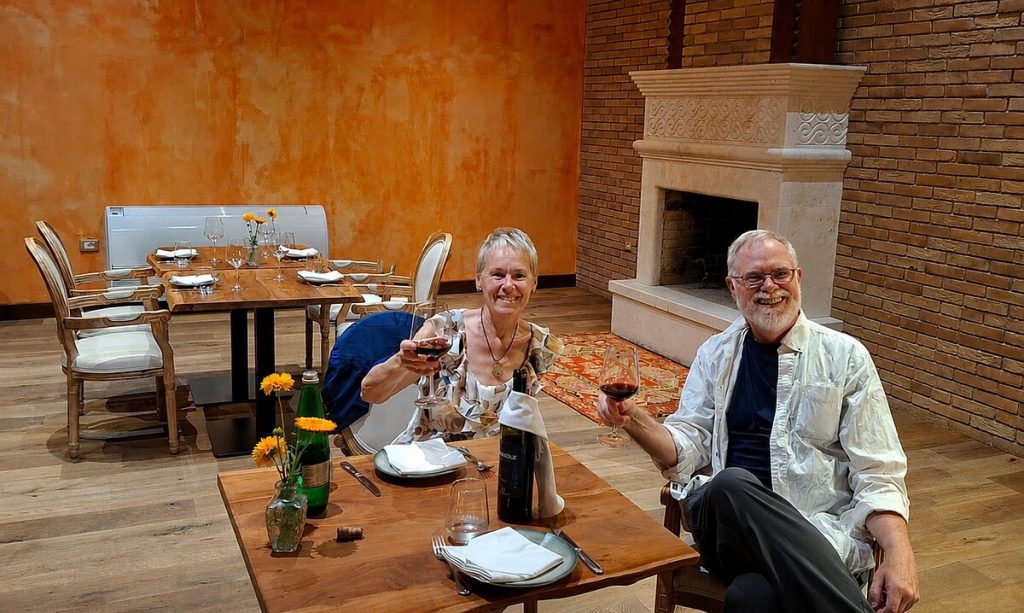
On the drive we stopped only for coffee and snacks, and so at the “agritourism concept” hotel where we stayed we indulged ourselves with a great farm-to-table dinner and a final bottle of Albanian wine. Gëzuar! (Albanian for “cheers”.)
Wednesday, May 27, 2026 – Laknas (near Tirana), transit LHR, Vancouver
The next morning, we did pretty much nothing but have a leisurely breakfast then grab a taxi to the nearby airport for our flights home in the early afternoon. We left as the hot weather arrived; on our departure day it was over 30 C,, while we had enjoyed lovely low to mid 20s temperatures the whole month, with only 3 days on which it rained. Nothing remarkable about the flights home, security at Heathrow was incredibly annoying (again), and BA’s meals and service were passable, and they got us there on time. Jet lag recovery from a 9-hour time difference was difficult, but worth the price for such an enjoyable and interesting trip!
You can see links to all of our posts for this trip on our Trip Page at 2026-2 – Greece and Albania.
Pictures from Southern Albania Tour
See our pictures of our tour of southern Albania on Flickr:
www.flickr.com/photos/100countries/albums/72177720334344654
See links to all of our posts for this trip on 2026-2 – Greece and Albania.