
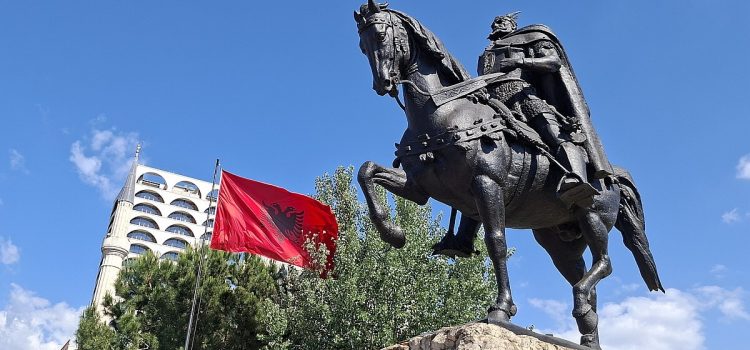
Tirana, Albania: Two Days in a Rapidly Changing Capital
Our two-day stay in Tirana, Albania was a re-introduction to modern Albania after our first visit in 2015. The country has certainly undergone massive change in a short period of time. Our visit was brief, but we felt that we had adequate time for historical exploration, cultural experiences, and getting a feel for a city reinventing itself at a rapid pace.
Wed., May 20, 2026 – Athens, Tirana
We arrived in Tirana early in the morning on our flight from Athens and were pleasantly surprised to be able to check into our apartment by 11:00 a.m. After settling in, our first task was to purchase a local Vodaphone SIM card, providing us with connectivity for our week in Albania. (Maybe it’s a legacy of the country’s history, but our travel SIM which works in over 120 countries didn’t work in Albania.)
With the practicalities taken care of, we headed a few blocks to Skanderbeg Square, Tirana’s central gathering place and and ground zero for Albanians’ reverence for national hero Skanderbeg. The square is surrounded by many of the country’s most important landmarks and provided an ideal starting point for our orientation. We visited the nearby Et’hem Bey Mosque, admired the mosaic on the exterior of the National History Museum, which was unfortunately closed during our visit (as it has been for 2 years and will be for at least 2 more), and snapped many, many photos of the Skanderbeg statue. AI says that “The blend of architectural styles and religious traditions reflects Albania’s complex history and diverse cultural influences.” However, most Albanians seem to view the 400 years of Ottoman rule not as a “cultural influence” but an oppressive occupation.
The main event of our first day was a visit to BunkArt 2, a museum housed in a former Cold War bunker. This recreated bunker entrance over a secret tunnel is one of ~180,000 bunkers built across Albania by the paranoid looney-tune, Enver Hoxha. The exhibits described the dictatorship of Hoxha and Albania’s decades of self-imposed isolation from much of the world. The museum showed how deeply the communist regime penetrated everyday life and how extensive the state security apparatus had become. And all done with some humorous twists such as the “spy-robot”. One quote from Hoxha summarized it all:
The border, a checkpoint against foreign ideology … the People’s Republic of Albania is closed to enemies, spies, hippie tourists and other vagabonds …
That complete closure of the entire country was clearly demonstrated when we were first anywhere near Albania in 1979. We were forced to take a ferry from Dubrovnik, Yugoslavia to Greece to detour completely around Albania. As the night-time ferry steamed past the Albanian border, the twinkling lights on the Yugoslavian shore became, literally, a dark spot on the map for hundreds of miles.
As we walked through Tirana, two impressions stood out. The first was the extraordinary pace of development. Having previously visited Tirana in 2015, we were astonished by the amount of construction now taking place. Tower cranes were everywhere, and new residential and commercial high-rises have transformed the city. Tirana appears to be experiencing a building boom unlike anything we remembered from our earlier visit. However, it should be noted that just about everyone that we spoke to agrees with “experts and investigative journalists who widely attribute the construction boom in Tirana to massive inflows of illicit wealth and systemic corruption”. (Tirana Times)
Our second observation was somewhat less expected: smoking was ubiquitous. Whether seated at outdoor cafés, walking through public spaces, or socializing in the evenings, a large proportion of people were smoking. The prevalence was noticeably higher than what we are now accustomed to seeing in most Western European or North American cities. (Note: Wikipedia confirms that Albania has one of the highest smoking rates in Europe at around 40% and rising, and says “Although the law technically forbids the smoking of cigarettes in public spaces like restaurants, bars, work places, etc., Albanians regularly smoke in those places.” Yup.)
The day concluded with dinner at Oda’s Garden, where we enjoyed traditional Albanian cuisine accompanied by live folk music. The relaxed atmosphere, local dishes, and musical performances were a fine introduction to Albanian hospitality and culture (not to mention Albanian wine). Check out our YouTube video of the patrons dancing through the restaurant, out onto the street, and back again:
Thur., May 21, 2026 – Tirana
Our second day focused on exploring additional sites connected to Albania’s communist era and recent history. We began with a walking tour that included several significant landmarks. Among them were the Pyramid of Tirana, originally built as a museum dedicated to nutty dictator Enver Hoxha and now repurposed for modern use, and Postbllok Memorial (Checkpoint Monument), “a powerful open-air installation featuring a brightly painted section of the Berlin Wall, concrete support pillars from the notorious Spaç forced-labor camp, and (yet another) communist-era defensive bunker” (Wikipedia). We also passed by the Mother Teresa statue located in front of the St. Paul’s Catholic Cathedral. Albania lays claim to her as a native daughter despite the fact that she was born in Skopje, Macedonia; apparently they can squabble over just about anything in the Balkans!
We also viewed the exterior of Hoxha’s former residence, located in the Blloku district. During the communist era, this neighbourhood was reserved for party elites and was inaccessible to ordinary citizens. Today, Blloku has become one of Tirana’s most trendy districts, filled with cafés, restaurants, and nightlife venues. Nearby, we stopped outside the House of Leaves Museum, where the plain exterior of the former HQ of the Sigurimi secret police conceals another of the city’s museums of the communist times.
After our walking tour wrapped up, we went into the House of Leaves Museum for details about the surveillance state that operated under communist rule. Through documents (way too many documents!), equipment, and personal stories, the exhibits revealed how extensively citizens were monitored and how fear and suspicion became just a part of daily life. Together with BunkArt 2, the museum captured a period of Albanian history that remains within living memory for older residents. Exhausted from perhaps a bit too much communist-era history, we grabbed a drink to sip in the Youth Park. Then, on our way back to our apartment, we made time to visit the interior of the Et’hem Bey Mosque, having heard about some of its unusual features while on our walking tour.
Later that evening, we made our way to the Sky Club at the Sky Tower Hotel. From its revolving restaurant and bar, we enjoyed drinks while watching the sun set over the city. The 360° panoramic views highlighted once again the dramatic transformation underway in Tirana. New towers, construction sites, and modern developments stretched across much of the skyline.
Fri., May 22, 2026 – Tirana, start tour of southern Albania
Our third day in Tirana was simply a 9:00 a.m. departure to begin our tour of southern Albania. Tirana’s museums and monuments helped us to understand Albania’s communist history, while its construction boom suggested a country looking firmly ahead. The contrast made Tirana a very interesting destination on our Greece and Albania trip. Although if Albania really hopes to join the EU, they are going to have to get a handle on the smoking in bars and restaurants, and the money laundering!
Pictures from Tirana, Albania
See our pictures of Tirana on Flickr:
https://www.flickr.com/photos/100countries/albums/72177720334168112
See links to all of our posts for this trip on 2026-2 – Greece and Albania.