
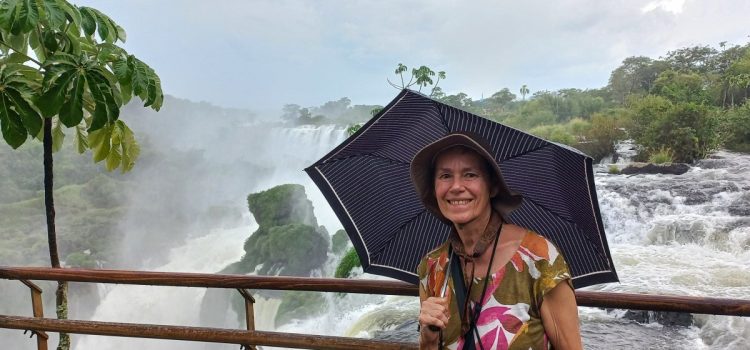
Iguazu Falls is situated just upstream of the Triple Frontier tripoint where Brazil, Argentina, and Paraguay meet. Only Brazil and Argentina have national parks with access to the falls and we visited them both.
Our post is titled “Return to Iguazu Falls” because we have visited once before, some 45 years ago on our very first trip to South America. However, as one of the three greatest waterfalls in the world (the other two are Victoria Falls in Zambia/Zimbabwe, and Niagara Falls between Canada and the USA) Iguazu Falls certainly warranted another visit.
Our first trip to South America was a whirlwind trip to five countries so we had just one day at Iguazu and saw only the Brazilian side of the falls. This time, we started our visit with a full day on the Argentinian side which is in some ways more impressive. Walkways take visitors to within metres of the edge of several of the more than 275 separate cascades that stretch across nearly 3 kilometres. And as our YouTube video below shows, the proximity to the roar and spray from the marquee waterfall, Garganta del Diablo ( “Devil’s Throat”) is very impressive. The Argentine network of walking trails is more extensive, but there’s a narrow gauge railway to shuttle passengers between stations for those less inclined to walk We certainly felt that the 30 minutes or so of border formalities to enter and leave Argentina from our hotel in the Brazilian town of Foz do Iguaçu were worthwhile.
On our second day at Iguazu, we remained in Brazil where an Uber to the park gate and a shuttle bus got us to the 1.5 km walking trail. We didn’t start walking right away, but crossed the street to Belmond’s Hotel das Cataratas to wait for the rain to ease up. Our first real rain in 2 weeks, so no real cause for complaint! Then, once the rain stopped, off to view the falls from another perspective.
Viewing Iguazu Falls from the Brazilian side is completely different than from the Argentinian national park. The falls are much further away and viewed from lower down, so it’s possible to see dozens of cascades at once, and see the tiers of falls stepping down to the river. There is one spot near the end of the only walking trail that is very close to one of the falls, but with the viewing platform being at about the half-way mark of the vertical drop the spray was the same intensity as a shower! Fortunately, we came equipped with raincoats. After taking the elevator back up to road level (via an elevator that we are 99% sure didn’t exist years ago), we took the shuttle bus back to the Hotel das Cataratas where we had a lunch reservation.
The bright pink Hotel das Cataratas has been an icon on the Brazilian side of the falls for nearly 70 years. It is the only hotel inside the national park, so that after the park closes, hotel guests have full access to the trails and viewpoints. On our first trip to Brazil 45 years earlier, the town of Foz do Iguacu wasn’t even one tenth the size that it is today, and Hotel das Cataratas was pretty much the only place to stay (and so we did). We didn’t even get to Argentina on that trip. Now, global luxury hotel brand Belmond has purchased the Hotel das Cataratas and moved the offering upscale significantly. That change meant that we couldn’t stay there on this trip because of their 4-night minimum stay for the carnaval (and Valentine’s Day) weekend, but it also meant that we could enjoy a fabulous weekend brunch at the new (at least to us!) Ipê Restaurant in the garden. The extensive buffet included the Portuguese specialty of feijoada (made with black beans and pork in Brazil), but only on Saturdays so it was a good thing that Valentine’s Day was a Saturday in 2026! In another Brazilian twist, the wine list was minimal, there were only a couple of beers on offer, but there was an all you could drink caipirinha bar. Caipirinhas are Brazil’s national drink (declared a Brazilian Cultural Heritage in 2003) made from very strong fermented sugarcane juice. Needless to say, we needed a nap after heading back to Foz do Iguaçu, and had just a tiny snack for dinner.


Having seen Iguazu from both Argentina and Brazil, it was time to fly to Manaus in the heart of the Amazon for the next part of our adventure.
See our pictures of Iguazu Falls on Flicker: www.flickr.com/photos/100countries/albums/72177720332213033
Visit our Uruguay and the Amazon page to see all of our posts from our first trip of 2026!