
When we left Montevideo for the short flight to Asunción, Paraguay, we were initially annoyed because Paranair changed us from a morning flight to a mid-afternoon departure, leaving us very little time to see Paraguay’s capital. As it turned out, that change was a blessing in disguise because:
- We were able to sleep in, still recovering from back to back 2:00 am carnaval celebrations.
- We avoided having to walk around Asuncion in 42 degree C temperatures. That’s 108 F!
Mind you, even at 6:00 pm when we headed out on a quick DIY walking tour of the historic centre of town it was still in the mid-30s. There’s not much left of colonial times, but we walked past the grandly named Panteón Nacional de los Héroes (National Pantheon of the Heroes) and other historic buildings such as El Cabildo (formerly the Congress, now a museum), the vice-president’s palace, and Palacio de López. Asunción’s cathedral, Catedral Metropolitana de Nuestra Señora de la Asunción, isn’t that impressive, but the former train station was interesting. Despite having had one of South America’s first train systems, with the beautiful Asunción Central Station at its heart, Paraguay let the network slowly decay, using steam powered locomotives into the 1990s. The entire railway system closed in 1995, the station was converted into a museum, and plans for re-opening the railway have been in progress for the past 30 years! We ended our quick walk at the Negroni Skybar for views of the sunset and the Río Paraguay. Dinner at the steakhouse next to our hotel completed our very brief visit to the capital.
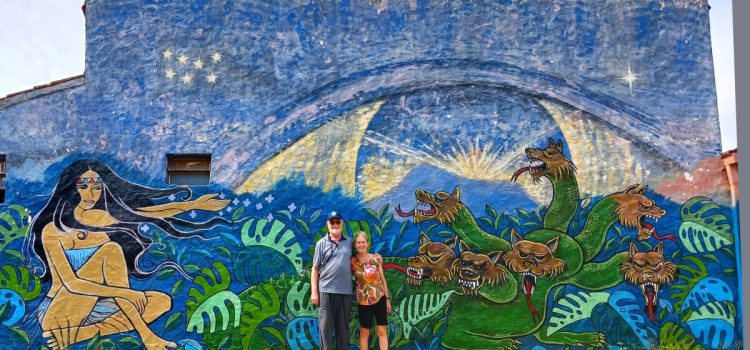
The following morning, we met up with Alyssa from Trico Tours for a 3-day excursion through the south of Paraguay. On our way out of town we drove by the tiny colonial house that is now the Museo Casa de la Independencia, then spent an hour or more thrashing through the suburbs that hold over 50% of the country’s population. Our first stop was a unique museum, the Museo Mitologico Ramon Elias. Ramon Elias was a professor and sculptor who turned his home into a museum filled with his own sculptures dedicated to the Guarani creation myth. The Guarani are the indigenous natives of Paraguay. They lend their name to its currency and have their language as the co-official language of the nation. Once finally out of the city, we headed through the dusty countryside to the home, workshop, and brick yard of Nestor Portillo, who used a slowdown in the family brick making business to reinvent himself as a mask carver. We spent some time seeing both the brick making and mask carving processes (Nestor keeps both businesses going to hedge his bets apparently) and then painted our own masks as souvenirs. Our final stop of the day was the Franciscan Church in Yaguarón. Despite its rather plain exterior with a bell tower that looks to be on the verge of collapse despite the lack of any weight from bells, the church houses an absolutely amazing carved wooden alter. It’s easy to see why the Templo San Buenaventura is on UNESCO’s “tentative” list. (whc.unesco.org/en/tentativelists/6614) The balance of the afternoon was spent driving to our overnight stop in Santa María de Fe.
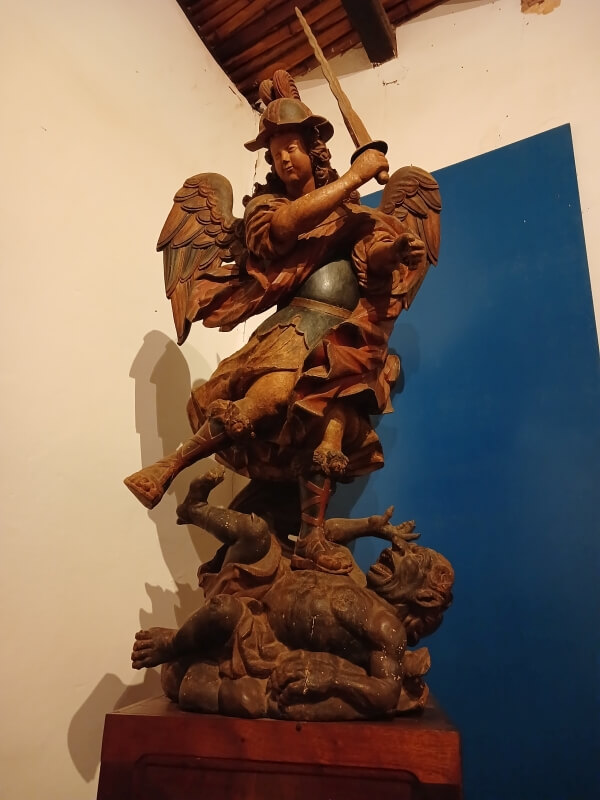
The town of Santa Maria is a quiet but charming place that was once one of the Jesuit mission towns known as “reductions”. After a morning stroll to a local spring, we returned to the main plaza and the adjoining Museu Diocesano de Arte Guaraní-Jesuíta. The Guarani-Jesuit Arts museum, housed in a typical row house built for the Guarani inhabitants of the village in the 1600s, holds over 50 sculptures from the now collapsed church. The Jesuits showed the Guarani Christianity by teaching them to carve using models, but the Guarani put their own mark on their works, with saints having decidedly indigenous features, and St. George slaying not a dragon but a man, reflecting the Guarani belief that each human contains both good and evil. An interesting museum for sure. Not sure that they get many visitors though, since after our tour the young woman collecting admissions locked up the museum door and came out with us to the plaza to look for howler monkeys in the trees!
Having had no luck seeing any monkeys in the plaza, we drove to a nearby animal refuge (which seemed more like an old school zoo) for guaranteed sightings of Paraguayan fauna. After that short stop we continued on to the first of the missions that we would visit, the Jesuit Reduction of San Cosme and San Damian. This mission from the 1600s still has a functioning church today, but is more famous for being the workplace of Father Buenaventura Suárez. With the help of the Guaraní people over the course of 47 years in the early 1700s, he built astronomical devices such as sundials, telescopes, quadrants, etc. and published some of the first astronomical data from the southern hemisphere. But all that is left of his instruments is a sundial in the church courtyard.
After a short lunch stop, we drove for several hours to Bella Vista. Over the course of the drive the landscape changed from dry flatlands to rolling hills with green pastures. We stayed the night in this small town because it’s close to the UNESCO site of the Jesuit Missions of La Santísima Trinidad de Paraná and Jesús de Tavarangue (whc.unesco.org/en/list/648), Paraguay’s only UNESCO site. We had time in the evening to check out the sound and light show at the Mission of Santísima Trinidad del Paraná. We’re not sure whether the low attendance (about six of us) was reflective of the incomprehensibility of the show or the general lack of tourism in Paraguay!
The following morning, before returning to the missions, we visited a yerba mate production facility. We had pictured a tiny farm, but this was a huge plantation with dozens of workers, industrial sized drying ovens, with the mate leaving in commercial packaging by the truckload. That scale of operation probably makes sense given Paraguayans’ (and Uruguayans’) obsession with the South American caffeine beverage of choice. Fully energized from a free yerba mate sample, we returned to Santísima Trinidad del Paraná to see the full scale of the ruins, the most complete of over 30 missions run by the Jesuits in the 17th and 18th centuries in Paraguay, Argentina, and Brazil. While the Trinadad mission was the most complete, giving a sense of how each community was organized, the second mission, Jesús de Tavarangue, was perhaps more impressive with its Moorish arches and watchtower from whose walls the nearby green hills could be seen.
In the afternoon, we had a 4-hour drive to end our tour in Ciudad del Este, Paraguay’s city at the tripoint where the countries of Paraguay, Brazil and Argentina come together below Iguazu Falls. We quickly got out of the rather seedy city via the bridge to Brazil. The complex of 275 waterfalls at Iguazu will be the subject of our next post
See our pictures from Paraguay on Flicker: flickr.com/photos/100countries/albums/72177720332085615
Visit our Uruguay and the Amazon page to see all of our posts from our first trip of 2026!