
On our final day at Estancia El Ceibo, we did relatively little (well, nothing really!) except enjoy a big farm breakfast and then another meal at lunchtime. Then, it was time to get a ride into the dusty town of Florida and head to the capital of Montevideo The bus ride was positively luxurious; fully air conditioned and with onboard wifi. From our taxi from the transportation hub of Tres Cruces down to our hotel, Montevideo provided a great first impression, with tree lined streets and many handsome art deco buildings. However, none of the beautiful buildings could compare with our “hotel” which was an apartment in the Palacio Salvo, a former luxury hotel converted into ~400 private apartments (and some offices in the former ballroom on the first floor). Having had two huge meals before leaving the estancia, and spending half a day in pick-up trucks, taxis and buses to reach Montevideo, we weren’t particularly hungry so we just strolled around the adjacent Plaza Indepencia for some evening views and had some pate, cheese, and wine for dinner.
Our first full day in Montevideo began with a walking tour starting at the Puerto Mercado a kilometre or so away by the cruise port. There is hardly a trace of the colonial Spanish era left except for the layout of the city. There are now squares where fortresses once stood, but in the 19th century much of old Montevideo was modernized. The result is what our tour guide referred to as the “Montevideo milkshake” of architectural styles ranging from baroque and neo-classical to Hauptmann and art deco. As we walked along, we also tried to keep track of of the complex history of Uruguay. Having had to fight two wars of independence and fend off incursions from Portugal England, Argentina, and even Paraguay, it’s a wonder that the tiny nation (less than 4 million total population) is still around. Our walking tour ended at the an observation floor of Intendencia de Montevideo (City Hall) for a view of the historic centre, the bay, Rio Plate, and even the distant monte (mountain) giving the city its name. (The tiny hill of 132 m / 433 ft is considered a “mountain” in Uruguay since the country’s highest point is a mere 514 metres.)
In the afternoon we took a tour of our hotel, the Palacio Salvo! We heard on our walking tour that the Salvo has been an icon of the city since its construction in 1928, and justifiably so. From bronze sculptures on the ground floor, stained glass at the top of the grand staircase, and Italian marble throughout, the whole building is a showpiece. After seeing the views of the Plaza Indepencia (and the Canadian embassy) from the observation level, we finished the tour at a small tango museum, the former site of one of the city’s first tango clubs. (Oddly, for men only at the time; gentlemen would practise their dance moves at an elegant club before heading for the bars by the port to meet ladies of the night who would tango for cash! No respectable woman would dance the tango until decades later.) In the evening, having reached the sea, we dined on shrimp, then spent hours online trying to persuade the local ticket service to sell us tablado tickets on a foreign credit card.
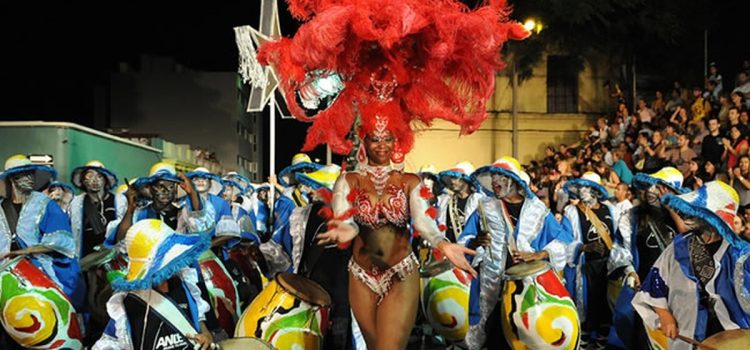
What’s a tablado? Tablados are musical, comical, and satirical acts by extravagantly costumed performers and they are a mainstay of Montevideo’s “carnaval”, famous for the 40-day event being the longest pre-Easter carnival celebration in the world. The tablado shows are held every night at makeshift, open air stages scattered across the city. And if it rains then the tablados are rescheduled so that the party can last up to 50 days! But before we went to that evening’s show we checked out a couple of Montevideo’s museums. The Museo Del Gaucho Y La Moneda (literally the Gauchos and Money Museum) was extremely interesting. The museum detailed the history of “gauchos” (usually translated as cowboys) from itinerant cattle thieves, to freedom fighters, and then the skilled horsemen that made the Uruguayan ranching business possible. Housed in the former headquarters of a major bank, the museum tied the first gauchos who spurned any need for money, to the last of the gauchos who became a key element in the creation of wealth, ultimately to be featured on the coins and bills of the “Money” part of the collection. Gauchos are long gone (see our video of a modern rancher herding sheep by truck!), but the culture lives on at every asado.
Como arquétipo nacional e guardido das tradicoes, o gaucho pode ser adivinhado ou pressuposto em cada rancho ou fazenda e em cada tarefa no campo.
As a national archetype and guardian of traditions, the gaucho is guessed or presupposed on every ranch or farm and in every field task.
We did hit another museum in the afternoon, the Museo de Artes Decorativas (Palacio Taranco), and while interesting it was really just an elaborately decorated old house. That evening, we had an early dinner (by Uruguayan standards) and arrived at the tablado performance an hour or so after the scheduled start time, when the opening act was just underway. The acts continued one after another until 1:00 am when we bailed out; who knows how long they went? The ridiculously long intervals between troupes as the stage was reset did provide ample time for getting beers and cocktails from all the food and drink vendors around the seating area. Sadly, our near total lack of Spanish meant that we missed most of the comedy except for the slapstick, and all of the satire, but the music was good and the costumes were over the top. Check out our video below:
Naturally we had to sleep in a bit, then the following day we did have time to see the Museo de Historia del Arte y de Arte Precolombino y Colonial, but it wasn’t that compelling. The main event of the day was the second of two parades that are the centrepiece of Montevideo’s carnaval, El Desfile de Llamadas (“the Parade of the Calls”). Wow, what a show. As on the previous night, we arrived about an hour after the scheduled 7:30 pm start time when the warm-up acts were going by our seats in the bleachers. Then the 25 troupes on the program began. Each troupe featured common elements of sign bearers, flag wavers, sun and moon symbols, dozens of dancers, some “old man and woman” acts, solo artists, and then up to 100 drummers beating out the candome rhythms of the call”. The noise of the drums was tremendous and so the groups had to be spaced far apart, meaning that by the time that we called it a night around 1:30 am there were more acts still to come!
Click the image below to visit our Desfile de Llamadas post with YouTube videos:
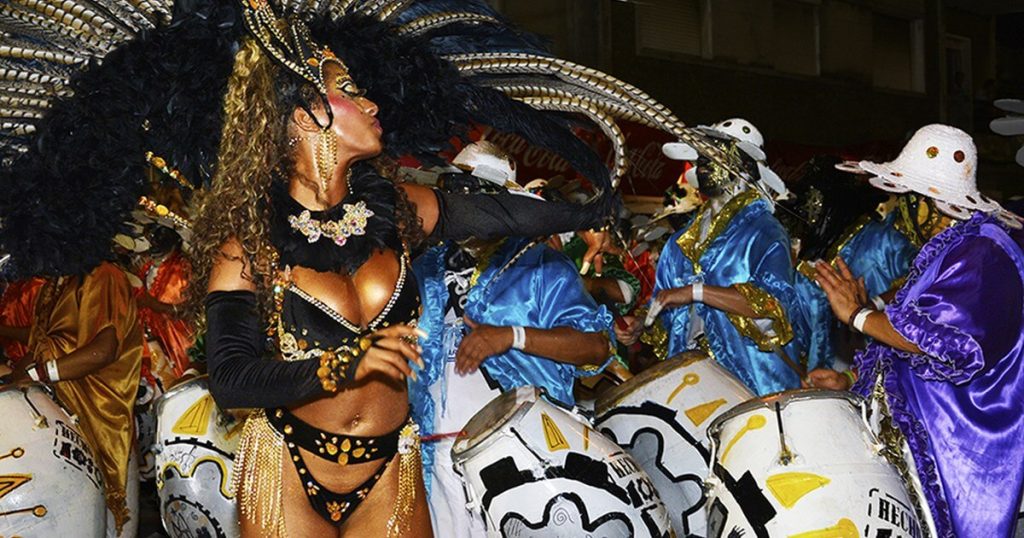
Our last day in Montevideo started late again of course, but we had one more museum to see, the Museo del Carnaval, which showed the local character of the tablados and parades, and the evolution of the costumes. We then relaxed in a wine bar near the market and sampled several of Uruguay’s fine wines, including the signature tannat varietal. Inspired by the afternoon’s wines, we dined at a restaurant named Tannat. As usual, we had to split a meal between the two of us; in Uruguay an entrecôte steak of 350 grams (3/4 of a pound) is considered a meal for one!
Montevideo is a lovely, laid back city to visit. Sights have to be sought out but are all the more interesting for that effort. And then for us, it was time to move on to Paraguay the following day.
See our pictures from Montevideo on Flicker: https://www.flickr.com/photos/100countries/albums/72177720332045934/
Visit our Uruguay and the Amazon page to see all of our posts from our first trip of 2026!